
A Door in the Ivory Tower

My Sustainable Encounter with Dr. Arghya Majumder
The chasm between academic theory and industrial practice is a well-documented source of stagnation, mutual distrust, and wasted potential. It results in research that remains purely theoretical, curricula that fail to prepare students for real-world challenges, and an industry that views academia skeptically. Many leaders lament this gap, but Dr. Arghya Majumder diagnoses it not as a simple misalignment of incentives but as a fundamental failure of empathy and understanding. His "driver's seat" doctrine posits that true knowledge is inseparable from direct experience and consequence. It is a sharp critique of abstract knowledge and a radical, if controversial, solution requiring the merging of these two often disconnected worlds forcefully.
The Failure of Abstraction
Majumder’s diagnosis of the root cause of the problem is unforgiving. He uses an analogy to describe the purely theoretical academics: they are like people who can write "big, big papers on how to swim" but have never actually entered the water. For him, this illustrates a profound "failure of empathy" born from the "human ego" that believes a complex system can be mastered from a safe, theoretical distance. This abstract knowledge, he argues, lacks the essential dimension that only applied, hands-on experience can provide. He believes many academics have never "understood the crux of the industry" or its real needs, so they cannot possibly offer meaningful solutions. This creates a cycle of irrelevance, where academic output is ignored by industry, further reinforcing the ivory tower's isolation. The knowledge produced is sterile because it has never been tested by the messy, unpredictable reality of implementation.
The Credibility of Consequence
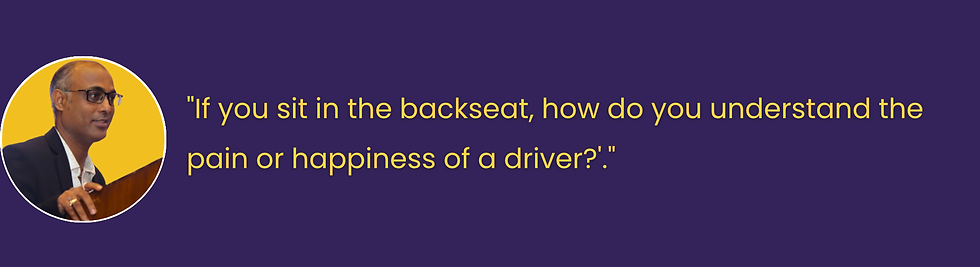
This critique is crystallized in the "driver’s seat" doctrine. He asserts that true understanding is the exclusive domain of the person bearing the consequences of their decisions. He asks, "If you sit in the backseat, how do you understand the pain or happiness of a driver?". This, Majumder posits, is the core of the industry's distrust. Leaders instinctively recognize academics as perpetual passengers, offering advice without ever having to bear the risk or responsibility for the outcome. Only the person in the driver's seat can truly understand the "agony, whatever he's facing". True credibility, in Majumder's view, comes only from responsibility born in consequence. It is the currency earned by having skin in the game. Without this direct experience of risk and reward, of success and failure, any offered solution remains a to-be-tested hypothesis.

The Mandatory Bridge
Majumder’s proposed solution is a radical restructuring. He advocates for a "mandatory" two-way exchange where industry leaders return to universities and professors must spend years working in industry. He sees the "professor of practice" model as the institutional embodiment of this philosophy, a way to bring seasoned industry leaders into the university setting. This is not just a policy recommendation. He believes this "interchanging of things must happen. Otherwise, civilization will never grow". It is his idealistic paradigm for forcing the worlds of "knowing" and "doing" to merge into a single effective system. While the "mandatory" nature of his proposal is a point of significant contention, it reveals the urgency with which he views the problem. For him, the gap is not a minor inconvenience to be managed but a critical flaw in our civilizational engine that requires a fundamental and forceful repair.

So what can we take from his approach?

Questions for Audience
Majumder's "driver's seat" doctrine correctly identifies that direct experience builds credibility. But are there situations where the "passenger's" detached, big-picture perspective is essential for strategy and innovation? Can a person be too close to a problem to solve it effectively?
Given the extreme impracticality of a "mandatory" exchange between industry and academia, what are the realistic, incremental steps that could be taken to build a more effective bridge between these two worlds?


Comments