
A Lesson from the 1990s in Circular Economy

My Sustainable Encounter with Dr Yogendra Saxena
Long before the 'circular economy' became a corporate buzzword, a cement plant in India was already pioneering it. What can this early act of industrial ecology teach us about genuine, long-term innovation? Their foresight and courage to adopt these principles before they were widely recognized is truly inspiring.
Today, the concept of a 'circular economy', an economic system aimed at eliminating waste and the continual use of resources, is a ubiquitous and fashionable topic discussed in boardrooms and sustainability reports worldwide. We celebrate it as a modern, innovative solution to our linear 'take-make-waste' industrial model.
But a conversation with Yogendra Saxena, a 35-year pioneer of Indian sustainability, serves as a potent reminder that true innovation is not about adopting the latest trend. It's about adopting a timeless attitude of resourcefulness. His work in the 1990s demonstrates that the principles of a circular economy were already being masterfully applied, not because it was fashionable, but because it was logical.
The Challenge of a 'Dirty' Industry
Let us set the scene in the 1990s. The industry is cement manufacturing, a sector notoriously resource-intensive and a significant source of pollution. The task was setting up major greenfield projects for Ambuja Cement. At that time, the common approach would have been to build a standard plant, focusing on production first and addressing environmental consequences later, if at all.
Yogendra’s approach was not just different, it was proactive and determined. He was not just a manager; he was a practitioner with a conscience, 'determined to do things the right way.' This foundational attitude led him to champion the use of Environmental Impact Assessment (EIA) studies for these projects, a practice he notes was a 'relatively new concept for corporates at that time.' He was not just following the rules; he was establishing a more responsible way of operating before the rules even demanded it.

An Attitude of Innovation
This proactive attitude led to his most prescient innovation. He saw a systemic connection that others missed. Nearby thermal power plants produced a massive amount of waste fly ash, a pollutant that required disposal. Simultaneously, his cement plants required specific raw materials. Instead of seeing two separate industrial processes, he saw one interconnected system. This systemic thinking is enlightening and can inspire us to look for similar connections in our own industries.
He initiated the use of this waste fly ash as a key input in the cement manufacturing process. 'These circular principles were not understood at the time but are talked about now,' he says. This was a groundbreaking act of industrial ecology, a field of study that examines the interrelationships between industrial systems and their surrounding environment. He took one industry's waste and transformed it into a valuable resource for another. The cement plant began to function like a forest, absorbing the waste of its neighbor and using it for productive growth. This was not the result of a consultant's report or a new regulation. It was the direct outcome of an attitude that sees problems not as isolated events, but as opportunities for intelligent, systemic solutions.

This story from three decades ago serves as a poignant lesson for today's leaders. It proves that genuine sustainability is not about the skillful application of the latest buzzwords. It is about cultivating a fundamental attitude of responsibility and resourcefulness. This core philosophy is the subject of our upcoming cover story on Yogendra Saxena, a true pioneer who was walking the talk long before most knew what to call it.

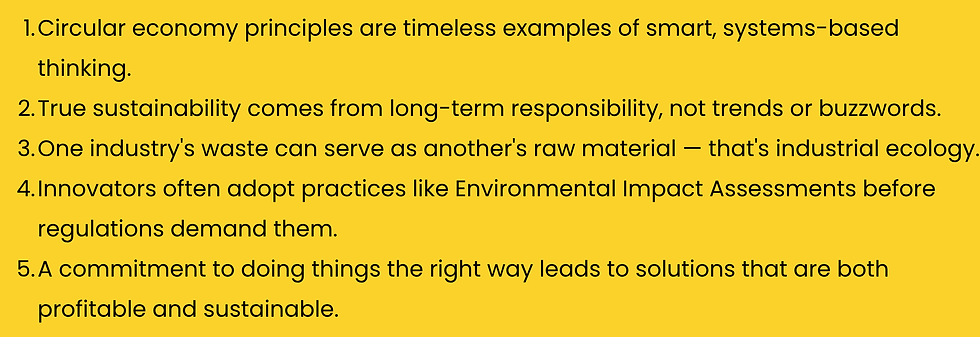
So what can we take from his approach?
Questions for Audience.
Yogendra's use of fly ash in the 1990s was an act of "industrial ecology" What are some modern examples of one industry's waste being used as a valuable resource for another, and what are the main barriers to adopting this practice more widely?
The blog highlights that Yogendra was driven by an "attitude of responsibility" rather than a prevailing trend. How can today's corporate leaders cultivate this same kind of proactive, forward-thinking attitude within their teams, instead of just reacting to current sustainability fads?


The 1990s cement plant story reveals timeless truths about sustainability. It prompts us to ask: Are we truly innovating, or just following trends? How can we cultivate genuine responsibility and systemic thinking in today's industrial landscape?
A modern example is using brewery waste (spent grain) as cattle feed or fertilizer. Another is capturing CO₂ from factories to carbonate beverages or make building materials.
Main barriers include lack of infrastructure, regulatory hurdles, inconsistent waste quality, and limited awareness or collaboration between industries.