
Making the Wrong Call

My NoSmalltalk session with Jay Shah
Infinite Containment
Consumerism does not sell products. It sells a single, pervasive feeling: the anxiety of the wrong choice. The system is engineered to generate a low-grade, profitable paralysis masquerading as convenient empowerment at a minimum investment cost. An infinite scroll of options, however, is not freedom. It is an easily misjudged cognitive burden. A thousand choices do not liberate a consumer. They imprison them. The time lost to this engineered indecision is a tax on our attention, a symptom of a market that profits from our inability to be satisfied.
A or B
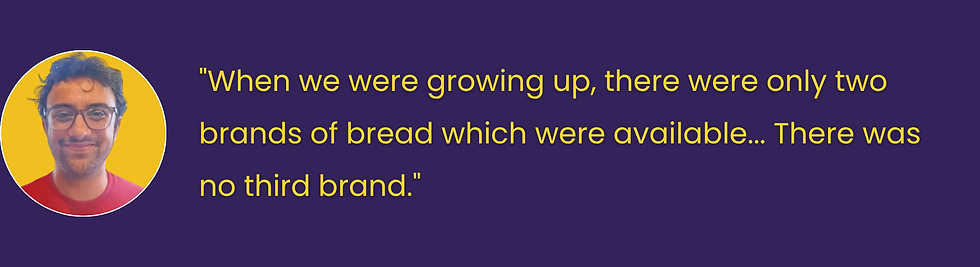
Jay Shah’s marketing philosophy is grounded in the memory of a different world, an Indian market of elegant simplicity. It was once a world of limited, tangible options. This was not a flaw of the system for him. It was its most essential feature. A market with only two bread brands is a market of absolute clarity. The consumer’s cognitive load dissolves to zero. The decision is direct, honest, and functional. The relationship between a human need and the product designed to meet it is clean, without the static of a thousand more colorful competitors. This finite world did not require the consumer or product designer to be a judgmental strategist. It allowed them to be a person with a need and have that need met with minimal friction.
Stupor of Plenty
The modern consumer, by contrast, is not a passenger in a simple transaction. They are a pilot in a storm of information. They are, in Shah’s incisive analysis, "spoiled for choices." To be “spoiled” is to be damaged by excess. The consumer, faced with an endless digital shelf, is now confused, anxious, and less capable of making a satisfying choice than ever. The psychological cost of choosing one option is the perceived loss of all the others. This leads to a state of paralysis where the optimal decision is often not to decide at all.
From Need, to Want, to Impulse
This paralysis has engineered a fundamental shift in the very nature of the market. Shah deconstructs this evolution in three stages. First was the needs-based market, where you bought one of the two available breads because you were hungry. Second was the wants-based market, where you chose from ten breads because you desired a specific taste. The final stage, our current reality, is the impulse-based market. In a system of overwhelming choice, rational decision-making collapses under its own weight. The only way to break the anxiety-fueled deadlock is through a sudden, emotional, and often irrational but orchestrated impulse. The purchase is no longer a solution to a problem. It is an outcry from the problem of choosing.

The Honest Embrace
This leaves an entirely new imperative for any brand that wishes to be effective. In a stuffed and deafening marketplace, the goal is not to become the loudest shout. It is to become the clearest recognizable signal. The function of authentic marketing is no longer to add another choice to the pile. It is to simplify the existing chaos. An effective brand provides a precise, reliable, and honest answer, reducing the consumer’s cognitive load and permitting them to stop searching. The responsibility has been inverted. It is no longer the consumer’s job to sift through the noise to find you. It is your job to provide a signal so clear that they will never forget it.

5 Lessons with practical values-

Open Questions
Is your own marketing strategy contributing to consumer paralysis by presenting another option, or is it actively simplifying their decision by providing a clear answer?
If the market now profits from our anxiety and impulse, what is the leader's responsibility to design systems that protect the consumer's cognitive health, rather than exploit its vulnerabilities?


Comments