
The Illusion of Knowledge. The Hard Truth About Information vs. Experience.

My NoSmalltalk session with Rajneel Kumar
The ease of access to information has created a dangerous illusion of understanding in the modern world. We have come to mistake the consumption of data for the acquisition of knowledge, a phenomenon that Rajneel "Neel" Kumar critiques with surgical precision. His analysis begins with a pointed observation from the world of product development: "anybody with an iPhone thinks they are a top-notch design expert and developer. And they would like to have their voice heard about what they feel about it". This statement is about feedback; it is an insight into a modern cognitive bias where possessing a tool is conflated with mastering the principles behind it. The user interface, designed for simplicity, masks the immense complexity of the system, leading the user to believe their familiarity with the surface equates to an understanding of the foundation.

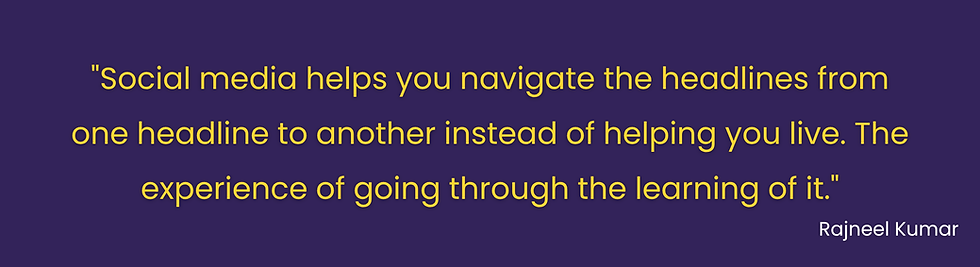
Neel draws a direct parallel from this to the way we consume information today. He argues that "social media helps you just navigate the headlines from one headline to another instead of helping you live. The experience of going through the learning of it". This is a critical distinction. The act of scrolling through summaries, hot takes, and curated video clips provides the sensation of being informed without the deeper cognitive process that comes from sustained engagement with a topic. It is the difference between reading the eight-line summary of a book and reading the book itself. We learn about things, but we do not truly understand them, creating a society that is widely informed but not deeply knowledgeable.
His own life provides a stark contrast. His formative experience was a "pre-Internet era" journey to the American Midwest as a 14-year-old. With no way to truly research his destination, he was forced into a state of pure, unmediated experience. His knowledge of this new world had to be built from direct observation and trial and error, not from pre-digested content. This state of "no guidance" made curiosity a necessary survival tool, forcing him to deconstruct his environment to understand how to fit in actively. This foundational experience created a deep respect for firsthand knowledge over secondhand information.
This shapes his view of the world today. He notes how people see "20 or 100 videos of Venice" and believe they know the city, when the lived reality is nothing like the curated highlight reel. He applies this directly to his own home: "6 years of living here [in Dubai], and the reason I love this place, and I call it home, is nothing. What social media shows it as". The core problem, he posits, is not that information is unavailable, but that it is "presented to see or be shown in a certain way". It is a curated reality, edited for maximum engagement. This distinction is crucial for any leader or innovator. If our understanding of a market, a problem, or a person is based on these superficial headlines, our solutions will inevitably be just as shallow. Genuine curiosity, in Neel’s framework, is the drive to look behind the curtain of curated information to get to the complex, often unglamorous, truth of lived experience.

5 Lessons I Learned from this Encounter:

Open Questions for Discussion
Neel argues that lived experience is superior to curated information. In a globalized world where we cannot possibly experience everything firsthand, what practical methods can we use to vet information more rigorously and combat this "illusion of understanding"?
If everyone with a smartphone can feel like an expert, how can true, hard-won expertise be effectively communicated and valued in business and society without being drowned out by the noise of uninformed opinion?


We can’t live every experience, but we can get closer to truth by asking better questions of our sources. Start by tracing information to its origin who said it, with what intent, and based on what experience? Prioritize long form content, expert interviews, and field-based perspectives over summaries and reels. Cross verify through contrasting viewpoints, not echo chambers. Most importantly, stay aware of your own sense of certainty if something feels too obvious or too smooth, it’s probably curated. Curiosity isn’t just about knowing more, it’s about doubting better.
True expertise doesn't just inform it explains why it matters. In a noisy world, credibility stands out when paired with clarity and context. Experts must go beyond jargon and share how they arrived at insights what they tried, what failed, and what they learned. Storytelling anchored in real experience is harder to fake, and far more persuasive than polished opinions. The goal isn't to silence the noise, but to build trust by showing the work behind the wisdom.
Neel’s story reminded me of how much we underestimate trial and error as a teacher. We’re so used to pre processed info that we forget the value of walking into the unknown with curiosity as our only tool.