


The Purpose Equation
What does executing a life of purpose mean? Is it a sudden revelation, or is it a long, calculated strategy, managed with the same rigor as a corporate balance sheet?
The architecture of modern achievement is built on a simple calculus: a life measured by what it accumulates. This principle is so deeply embedded in our professional and social structures that its logic is rarely challenged. But is this ledger of tangible assets, this quantifiable surplus of net worth, titles, and influence, an accurate measure of a life, or merely the most convenient one? For all its utility, this framework carries a significant liability. An unexamined life accrues a silent deficit. Purpose is not a luxury asset to be acquired after all other accounts are settled; its absence is a fundamental imbalance that depreciates every gain. Therefore, a true accounting of a life’s value demands a more rigorous audit, one that measures not what was kept but what was intentionally given away.
Narratives of personal transformation typically follow one of two scripts: the emotional epiphany or the desperate flight from failure. Deepak Sharma’s story conforms to neither. His decision to exit a 31-year corporate career was not a discovery, but a conclusion resulting from an eighteen-year strategic plan. He diagnosed the growing imbalance in his life not as a feeling to be placated, but as a systemic flaw in his operating model. His definition of this new guiding principle is uncompromisingly direct: for him, "purpose has to be beyond my family." The required response was not therapy, but a complete operational restructuring.
This, then, is an inquiry into the mechanics of a life deliberately re-engineered. It is the deconstruction of a man who turned the tools of corporate analysis inward, applying the rigor of a balance sheet to the amorphous concepts of meaning and legacy. He approached the act of giving back not as a sentimental add-on, but as the most demanding and significant venture of his career, one where the only acceptable return is a life of audited purpose.

“Purpose is not a luxury asset to be acquired after all other accounts are settled; its absence is a fundamental imbalance that depreciates every gain.”

A Deliberate Deconstruction
How does conviction survive eighteen years of contradiction? For Deepak Sharma, the process began at age 36 with identifying a fundamental flaw in his life’s operating model: it was designed entirely around the self. This was not an emotional catalyst for immediate change, but the first data point in a long-term strategic analysis. The immense psychological discipline required to live this duality is a testament to the clarity of his conviction. For nearly two decades, his external life as a corporate leader was entirely subordinated to his internal mission. The corporate world was not an identity to be cherished, but a system to be leveraged. It provided the resources and structure necessary to systematically deconstruct the obstacles preventing his exit. His conviction was sustained not by rejecting his daily reality, but by transforming it into an 18-year project with a single, ultimate goal.
This reframing of time and purpose leads to a more fundamental inquiry into the nature of duty: how does one define the endpoint of personal responsibility to justify a pivot to a larger, societal one? Deepak’s plan provides a clinical answer. He established two clear, parallel workstreams that functioned as contractual obligations. The first was financial. A life of volunteering required absolute financial independence, so he spent nearly two decades meticulously planning his finances to ensure a “reasonable standard of living” was secure. The second workstream, the familial, was defined with the precision of a project manager. Believing a parent’s “primary responsibility is to get the best of education for their children”, he treated this duty not as an endless emotional obligation, but as a finite mission with a clear deliverable. His role was to provide the tools for his son’s independence, not to underwrite his entire life. Once his son graduated at age 22, that contract was fulfilled. The transition, therefore, was not a leap of faith but the "perfectly timed" conclusion of a meticulously managed plan.
This systematic dismantling of obligations explains his unequivocal response when asked if it was difficult to relinquish corporate power and prestige: “It was absolutely not”. There was no internal friction because the decision had been amortized over seventeen years. The corporate identity, with its metrics of income and authority, had already been rendered obsolete in his personal accounting. His internal balance sheet was already running on a different system that valued purpose over profit. The self attached to a title had been systematically replaced by the self dedicated to a mission. His only reflection on the matter is strategic, questioning if the plan was too conservative. “Sometimes I feel that I could have taken that decision. Maybe when I was 45 or 48,” he muses. It is the observation of a satisfied man, analyzing a successful launch not with nostalgia, but with an unwavering focus on optimizing the next, dedicated venture.
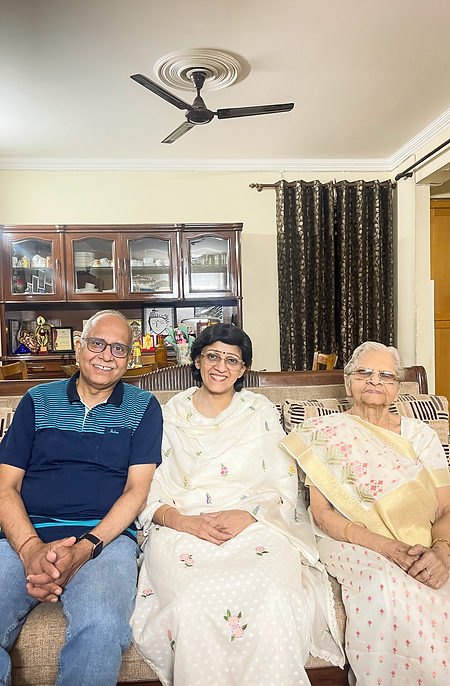
“For nearly two decades, his external corporate life was entirely subordinated to a single internal mission.”

“The solution was not to learn a new management technique, but to unlearn the very impulse to manage.”
Unlearning Ownership
A successful eighteen-year plan had equipped Deepak Sharma with the financial and logistical freedom to begin his new venture. However, the intellectual and psychological restructuring was a challenge that no amount of planning could pre-empt. The skills that build a corporate career are not universally applicable. He discovered that the very instincts that made him effective as a national head were liabilities in his new context. His most difficult work began after the transition was complete: the systematic unlearning of an identity built for profit to adopt one built for purpose. This required him to answer a difficult question: what happens when a lifetime of practical leadership tools is suddenly rendered obsolete?
In the corporate sphere, Deepak operated as an “owner”. This role demanded a specific mindset: as a leader, you are assigned targets, you monitor them, and you are responsible for achieving them to contribute to the “organization's bottom line”. This creates a culture where a certain authoritarian efficiency is a virtue. “Whatever I'm saying has to be followed,” he explains of that mindset. Upon entering the development sector, this approach met an immediate and immovable wall. The children he was now responsible for were not a team to be managed towards a target, but they were individuals from “highly traumatized backgrounds”. He admits he had “no experience handling such a type of children”. The realization was stark: the for-profit and non-profit worlds are “2 different worlds” where a “one size fits all doesn't work”.
The solution was not to learn a new management technique, but to unlearn the very impulse to manage. Guided by his mentors at the NGO, he understood that his primary function was no longer to direct, but to receive. His most valuable contribution was not his opinion, but his attention. The core skill he had to master was to become a “very, very keen listener” and a “very keen observer”. This was the "big switch". This is where the philosophical seeds planted by his father, who taught that philanthropy could be the giving of time and knowledge, came to fruition. He transitioned from the mindset of an owner to that of a trustee. Trustees do not command resources for a bottom line; moreover, they steward them for a greater good. The shift was absolute, applying to everything in his possession. “I'm using this laptop. I am not the owner. I'm just a trustee,” he states. “Tomorrow I will not be there so that it will remain here. So I'm just a caretaker for whatever I have”. This unlearning of ownership and the embrace of stewardship was the most critical task in the operational launch of his life’s new venture.

The Verdict on Legacy: A Generational Reckoning
Dismantling a former self is only half of a restructuring. Once the old framework of ownership was unlearned, a new one had to be built in its place, founded on new ethical and philosophical anchors. For Deepak Sharma, the architecture of his new identity rests on two foundations: the distinct pillars of influence from the three women in his life, and the unflinching, logical conclusions these influences led him to on the nature of legacy. These elements combined to shape the final, most radical phase of his audit, where he moves beyond his own life to question the fundamental assumptions of generational wealth and duty, applying his rigorous logic to the most sentimentalized aspects of human existence.
The first pillar is built from the specific, non-overlapping wisdom of three matriarchs. His mother, he explains, provided the blueprint for inherited compassion. Married at sixteen and having only completed Class 12, she regretted her lack of educational opportunity. This fueled her insistence that Deepak “support as many girls as possible” and led to her profound act of philanthropy: donating her entire pension to the cause. Her philosophy of giving, however, found its ultimate expression in her final wish. Years before her passing, she pledged to donate her body to a medical college. Her reasoning was not spiritual but deeply pragmatic: cremation wastes wood and pollutes the air, while immersing ashes dirties the rivers. It was the ultimate embodiment of the trustee philosophy, a final, logical act of returning every possible resource to the system from which it came, free from the friction of ritual or sentiment.
The second pillar is his wife, whom he refers to as a “goddess”. She is not a passive supporter but an active partner and co-strategist in his mission. Her role is to challenge complacency and constantly amplify their impact. “If I say I would like to give ₹2, she would say, Why not ₹3?” he notes. This dynamic transforms their giving from a personal act into a shared strategic venture, a two-person brain trust dedicated to maximizing their return on purpose. The third pillar is Dr. Kiran Modi, his mentor in the development sector, who provided the essential professional framework for execution. If his mother and wife helped build his conviction, Dr. Modi gave him the practical wisdom to apply it effectively, bridging the gap between his rebuilt identity and real-world impact.
These influences, one of inherited compassion, one of active partnership, and one of professional execution, created the man who would deconstruct the idea of legacy. This forms the second foundation of his philosophy: a generational reckoning. Deepak’s logic is clear and uncompromising. He posits that while the purpose for a young person may be providing for family, that definition has an expiration date. For those over 60, he poses two soul-searching questions as a final audit on parental success and wealth. The first: “Please ask your children whether they need any portion of your wealth”. He argues that an answer of “Yes” means “we, as parents, have failed to raise and give the right values to the child”. The second is more direct: “Ask yourself what has been your child's contribution to the wealth you have created”. If the answer is zero, his deduction is clinical: “then why does he or she have any right to claim out of that wealth?”.
This is more than a casual critique of inheritance. It is Deepak’s fundamental demolition of the ethical basis from a trustee’s perspective. It attempts to apply corporate-style meritocracy to the one domain, family, where such logic is traditionally forbidden. He argues that the wealth one creates is not truly personal property to be passed down a bloodline, but a societal resource to be stewarded. Once the primary, finite duty of providing a child with the tools for their success is complete, that wealth should be redeployed “where people need it more”. This is the ultimate conclusion of his life’s audit. It replaces the sentimental legacy architecture with a starkly logical one, where responsibility is finite, entitlement is unearned, and our final obligation is not to our name, but to the society that enabled our success.

“If your child has contributed nothing to the wealth you created, why should they have any right to claim it?”


The Final Balance Sheet
When conducted with this level of rigor, a life audit leaves no room for ambiguity. For Deepak Sharma, the process was a complete overhaul of his personal and philosophical accounting. The initial eighteen-year plan was a strategic write-off, an amortized cost to eliminate the profound liability of an unexamined existence. The subsequent unlearning of his corporate identity was a necessary restructuring, a painful but essential process of shedding the non-performing assets of ego and authority. His final, uncompromising verdict on legacy represents the ultimate reinvestment, where all accumulated financial and experiential capital is liquidated and redeployed into a single, dedicated venture: a life of purpose.
What, then, is the final return on such an investment? It is not happiness, which is a fleeting dividend. It is not satisfaction, which can breed complacency. The ultimate profit from this lifelong audit is clarity. It is the state of a man who has successfully aligned every action, every resource, and every relationship with a single, unwavering mission. He does not hope his life has meaning; Deepak has engineered it to have nothing but. The final balance sheet is reconciled. There are no miscellaneous expenses, no sentimental assets carried at inflated values, and no debt owed to convention. It is the ledger of a life fully accounted for, a testament to the idea that the most valuable existence is not one that is found, but one that is meticulously, and ruthlessly, built.
“The ultimate profit from this lifelong audit is clarity.”
What I learned from Deepak Sharma.
-
Actual life-altering change is rarely an emotional whim. It is a strategic venture that requires meticulous, long-term planning, often while living in direct contradiction to the future you are building. Conviction is a project to be managed.
-
The most challenging part of a leader’s transformation is not learning a new skill but unlearning a successful identity. The instincts that create success in one system can be the primary obstacles to effectiveness in another.
-
Responsibility can be treated as a finite contract with clear deliverables. By defining the successful endpoint of one duty, like raising a child, you create the intellectual and emotional freedom to take on the next, broader one.
-
The "trustee" mindset is an all-encompassing operating system. It applies not only to financial wealth but to every resource, including knowledge, time, and even one's physical body after death.
-
The most logical definition of legacy has nothing to do with bloodline and everything to do with contribution. If wealth is a stewarded societal resource, its final, most rational destination is back to society, not to heirs who have no claim to its creation.

The Nature of Adversity
Adversity is a form of pressure, a spiritual physics with two potential outcomes. The first is fragmentation: the spirit breaks under the load. The second is compression: the spirit is forged into something more substantial, sharper, and more resilient. The journey of Vineeta Agrawal is a case study in this brutal alchemy, a deconstruction of the process by which the lead of oppression can be transformed into the gold of personal depth. Her story is not one of effortless empowerment, but of a long, draining, and isolating fight. It is an inquiry into the mechanics of a will forged in a fire she did not choose, but which she ultimately learned to command.
Her entire professional career is a consequence of a battle that began on an intimate front. As she frames the progression, her journey “began with my personal freedom. And then it ultimately graduated to professional freedom”. The immense restrictions placed upon her in her early life did not extinguish her ambition. Instead, they created the very fire that fueled it. This is more than the stereotypical narrative of overcoming obstacles and seizing opportunities. It is a complex examination of how a human spirit, when cornered, can harness the energy of its cage to break free.
The examination of this process must, therefore, answer a series of foundational questions. What were the circumstances of the constraint built around her? What is the precise mechanism that turns quiet endurance into a fierce rebellion? And ultimately, what is the true nature of the freedom won, not as a gift, but as the spoils of a long and challenging battle?

“Her story is not one of effortless empowerment, but of a long, draining, and isolating fight.”


“Her story is not one of effortless empowerment, but of a long, draining, and isolating fight.”
The Ignition Point: Pain as a Catalyst
The second foundational question addresses the mechanism that turns quiet endurance into a fierce rebellion. For Vineeta Agrawal, the catalyst was not a single event, but the sustained, crushing weight of a reality that was emotionally draining and intellectually insulting. The glamorized Bollywood narrative she had been sold was “artificial, very fake”. After her marriage at nineteen, the challenges of her constrained life became “10x” more difficult. The experience was, in her words, “physically, mentally, psychologically, emotionally, very draining”. This immense pressure created the conditions for change, but the ignition point was the terrifying realization: “if you don't have a professional degree, you will have to rot like this all your life”. Rebellion became a matter of survival, not just of the body, but of the self. The phrase “rot like this” implies a spiritual and intellectual decay, framing her fight as a battle against the erasure of her potential.
However, the proper fuel for the “fire in me” was not the hardship but the severe injustice of devaluing. Here, she makes a critical distinction: she never had a problem with the act of caring for her family. Her problem was doing “just that”. The core of her struggle was the implicit message from her environment that she was relegated to this role not by choice, but by a perceived lack of capability. The fight was against the corrosive assumption that “you're just supposed to do this because you cannot do anything else”. This was a fundamental denial of her identity and a form of psychological imprisonment. Her rebellion can be seen as an act of epistemology: a fight to prove a different truth about herself, to her world, and to herself. To be assigned a role is one thing; to be told that this role represents the absolute limit of your capability is different. The rebellion was not against the work, but against the system’s valuation of her worth.
This internal fire manifested externally. Gaining her education was a “constant struggle”. She had to “literally fight with everyone in the family, my parents, my husband, my in-laws, everyone”. To succeed, she sacrificed her sleep, health, and any semblance of a social life, studying until four in the morning to ensure her “grades were not compromised”. This was a strategic reallocation of all personal resources toward a single objective. She was running her life like a bootstrapped, high-stakes startup, proving her capability, being the only asset she had. Her ultimate academic success, achieving an All India rank and becoming the Eastern India Topper, was more than a personal achievement. It was an act of defiance paired with longed-for satisfaction. The irrefutable data proved the system’s core assumption about her capabilities, about her being a woman, was wrong. Her choice of chartered accountancy, a profession of rigor and logic, seemed a strategic refutation of the domestic, emotional sphere to which she was confined. She did not rebel with emotion, but with objective achievement. An All India rank could not be dismissed or devalued by the system she was fighting. The hard evidence proved her worth in a language her world understands.
The Paradox of Victory
The final foundational question addresses the nature of the freedom won through such a long and challenging battle. Victory, particularly one born from a fight for the self, is never a simple state of rest. For Vineeta Agrawal, the spoils of war remain complex. They have brought liberation but have also created a new and more demanding set of deliberate constraints. Her journey is a case study in the paradoxical relationship between power and freedom, demonstrating that the prize for escaping one cage is often the responsibility of building a new, more meaningful one.
The external transformation and its resulting validation are undeniable. She describes the starting point of her journey as being a “homely, introverted girl” who “could not speak to a person next door”. Now she is a leader so confident that she is compared to a "female version of Rajni Kant". This is not merely a change in personality, but the construction of a public-facing professional persona required for economic survival and business success. She is a person who now believes she “can do any possible task under the sun” and who fears “absolutely no one”. She credits the hardship of her early life for this change, stating that those years “really helped me become the strong, independent, fierce, resilient person I am today”.
This victory, however, came at a significant and measurable cost. To fuel her fight, she had to sacrifice a conventional youth. She had no time to “pursue any hobby” or to “go out with friends”. The “social part of my life was missing” from those formative years. Her assertion that she has “no regrets, no grudges, no complaints” is not a denial of this pain, but a reframing of it. It is the rational conclusion of a survivor who has run a cost-benefit analysis on her own life and found the outcome, however difficult, infinitely preferable to the alternative, which was to “rot like this all your life”. The pain was a necessary investment in her present strength.
This leads to the ultimate paradox of her new life. Having fought so hard for freedom, she now finds herself in a gilded cage of her own making. She clearly explains, “You look very free. You have the freedom, but you are not free”. The freedom she won was agentic, the power to make her own decisions. She sacrificed temporal and psychic freedom, the release from constant responsibility, and the immense mental load of leadership. Power creates new obligations to employees, to customers, and to the brand itself, which in turn constrain the powerful. Her resolution to this paradox is the final, and most important, insight. She distinguishes between the challenges that were forced upon her and the ones she now chooses. The pressures of her former life were ones she “didn't want”. While immense, the pressures of her current life are “good problems to have”. This is the definition of her victory. Her journey was a fight to become the author of her own life's challenges. True freedom, her story suggests, is not a release from struggle, but the agency to choose your own.

“You look very free. You have the freedom, but you are not free.”


The Forged Will
The final product of this alchemy is not one person at peace, but a will that has been tempered into an instrument of agency. Vineeta Agrawal’s journey deconstructs how such a will is forged. The architecture of constraint provided the raw material and the hammer. The severe injustice of being devalued provided heat. The result is an identity built on radical self-reliance and an unsentimental understanding of the world’s mechanics. Vineeta's mantra is a directed, relentless equation for growth: “Do more, learn more, grow more”.
This forged will is the foundation of her advice. Her final message is not one of comfort, but of necessity. She urges young women to “be on your own feet” and “be self-sustainable,” calling it “very, very, very important”. This is imperative for a world where she sees a decline in “love, faith, empathy, sympathy in humankind”. Her story, therefore, is ultimately a companion. It is a case study in forging the agency and resilience required to survive a ruthless world and choose your own terms of engagement with it.
“Do more, learn more, grow more.”
What I learned from Vineeta Agrawal.
-
Extreme constraint does not always crush; it can act as a crucible, forging a will with the strength and focus necessary for a high-stakes breakout.
-
The most potent fuel for rebellion is not mere hardship, but the intellectual and spiritual insult of being devalued and defined by your limitations.
-
Victory in a personal war is never clean. The price is often a sacrificed youth, but this is a cost a survivor deems a necessary investment in their present strength.
-
True freedom is not a release from struggle, but the acquisition of agency. It is the power to choose your own challenges and author your own life's problems.
-
Self-reliance is a survival strategy for a world where support is conditional on success, a lesson epitomized by the banker who only offers a loan when you no longer need it.

The Illusion Driving a Distorted Startup Culture
A peculiar and pervasive obsession defines the modern startup ecosystem. It is a culture that speaks the language of disruption and innovation but worships at the altar of a single, often misleading, metric: valuation. As Uttam Banerjee, co-founder of Ekam Eco, observes, the media has “created a bubble around valuations”. This has produced a generation of aspiring entrepreneurs who get into the “pressure of building valuations rather than building businesses”. To him, the entire model has been inverted. Success is no longer measured by profit or impact, but by the ability to raise capital.
This systemic flaw is evident in the questions the next generation of founders asks. When Uttam speaks at colleges, he notes that the “first question people ask is how to raise funds”. They are not asking about market-fit, value propositions, or the fundamentals of a sustainable enterprise. He counters with a more essential line of inquiry: “Do you have the product? Do you have a solution? Do you have a market? Do you have a business plan?”. Most of the time, he finds, “they have no clue about it”. Their focus is not on building a business but funding a concept.
The journey of Uttam Banerjee and Ekam Eco is a direct and deliberate refutation of this dominant ideology. His is a counter-narrative, a case study in what he calls the Bamboo Philosophy. It is a model that rejects the lure of fast, venture-fueled growth in favor of a slow, patient, and organic one. It prioritizes the difficult, often invisible, work of building deep roots, nurturing profitability, values, trust, and a resilient company culture, long before attempting to achieve exponential growth. This is an inquiry into that philosophy, a deconstruction of a business model built for a different, more sustainable measure of success.

“The media has created a bubble around valuations.”

The Slumbering Frontman

“This is an inquiry into that philosophy, a deconstruction of a business model built for a different, more sustainable measure of success.”
The modern founder is expected to be a frontman: charismatic, media-savvy, and perpetually comfortable on a stage. This archetype, reinforced by a media culture that often conflates charisma with competence, is treated as a prerequisite for success. Uttam Banerjee is a case study in the opposite. His journey as an entrepreneur is inseparable from his personal battle with a lifelong, debilitating fear of the spotlight. To understand his patience, his root-focused business philosophy, one must first understand the character of a leader whose natural inclination is to be behind the scenes, not in front of them. His evolution was not a pursuit of the spotlight but a necessary confrontation with his paralyzing fear of it.
His fear of public speaking was a core part of his identity. “Even right from childhood in my school and college,” he recalls, “I used to be very quiet, not raising hands to any questions the teacher would ask”. This behavior continued into his corporate career, becoming a strategic liability. He recounts a key project where he did the background work but deferred to his colleague for the presentation, telling him, “I'll just change the slides. You do all the talk”. This was his rational, if unsustainable, defense mechanism against a deep-seated, misguided fear of being judged incompetent. Entrepreneurship, however, strips the option to hide. A founder must be the primary advocate for their vision.
The first confrontation was his incubation pitch at IIT Delhi. He was “very nervous,” possessing no formal background in business or finance and presenting on sanitation, a “very different field for me”. His decision to proceed was not an act of sudden confidence, but of pragmatic analysis. He concluded, “If I don't face that here, I'll probably never be able to learn”. His decision to proceed was not an act of sudden confidence, but of a pragmatic and calculated analysis. The trial by fire came shortly after, when his professor pushed him onto the stage at a major UNICEF conference with little warning. The venue was a 700-seat seminar hall, a space that, for Uttam, “always used to be a terrifying place”. His memory of such halls was of “sitting in the back in the dark... looking at the stage, somebody else doing the job”. Now, he was being pushed into the light, “shivering like anything”, consumed by the fear of how experts would judge him.
The outcome was the opposite of what he feared. After he finished, the audience applauded, and people approached him to praise the presentation. This external validation was the first data point contradicting his internal feeling of failure. It led to a deeper, more analytical understanding of his fear. The advice of a skilled speaker aided this momentum. He learned two critical lessons. First, the "perfect presentation" only exists in the speaker's mind since the audience "doesn't know what exactly the perfect definition is" and might accept what is delivered. This insight shifts the focus from an impossible internal standard to the practical reality of value delivered. Second, he learned that the audience is an ally, not an adversary. “When you are on the stage,” he was told, “people want you to win, no matter what”. Even if it is questionable if this will always be the case, it shifts the reality of perception by reframing the dynamic from a judgmental evaluation to a collaborative exchange. For Uttam, the psychological stakes were drastically reduced. His journey was no longer reduced to facing fear, but defining his perception of his abilities.
The Non-Negotiable Contract
A philosophy is meaningless without a set of non-negotiable principles. For Uttam Banerjee, the "Bamboo Philosophy" is a strict, operational contract that governs every strategic decision. While most startups preach constant agility, Uttam's model is anchored by a persistent ethical core. This is not a lack of flexibility. It is a strategic choice to have a stable center of gravity, providing the resilience to withstand the chaotic pulls of the market and the venture capital ecosystem. This contract is built on three core tenets, prioritizing long-term sustainability over short-term gain. The cultural context for this is the concept of "dhanda," a pre-VC business that values sustainability and real cash flow over speculative valuation.
The first principle directly refutes the modern startup obsession: profitability before valuation. Uttam and his co-founder believe in the “traditional way of doing business”. They bootstrapped their company for the first three years, deliberately avoiding external capital. They didn’t fail to raise funds, but made a strategic choice to protect the company's core integrity. Uttam explains, “Having too much money at the wrong time would spoil your thoughts”. This principle identifies premature venture capital not as accelerating fuel, but as a potential toxin. It can force a focus on vanity metrics and rapid scaling before the core product and market are truly understood, often leading to a hollowed-out, unsustainable enterprise. This requires immense patience, directly linking to the "bamboo" metaphor of building invisible grounding roots underground long before noticeable growth occurs.
The second principle governs the selection of partners: values before capital. When they decided to raise funds, the process was not about finding the highest bidder, but the right partner. He describes the decision as “even more important than getting married to somebody”. The primary filter was not the size of the check, but the investor's character. He asks, “Apart from money, what other value additions can they bring to the table? Are they ethical... Do they share the same philosophy that we share?”. This treats investment not as a simple transaction, but as a long-term alignment of values and vision. They have “said no to a lot of people in the past,” even when they needed the funds, because a misalignment of values is a risk he is unwilling to take. This demonstrates a commitment to building a "high-trust, low-ego" ecosystem, where strategic alignment is valued more than capital itself.
The third and most critical principle was tested early in their journey: integrity at all costs. Shortly after starting, when they “desperately needed money in our accounts to run the company” and had “hardly had any orders”, they received an offer from a government-affiliated group to purchase 10,000 of their waterless urinal units. When Uttam asked the logical question, “Where would you like to install this?”, the buyers were evasive, telling him, “Why are you bothering about it... leave the rest to us”. This raised two red flags. The first was pragmatic. In a category already damaged by a previous internationally set failure, an unsupervised, mass installation could easily fail, giving his product a “bad name in the market” and destroying the trust he was determined to build. The second was ethical. The lack of transparency signaled potential corruption, an “unethical activity” in which he refused to participate. They respectfully declined the offer. This decision, made at their most vulnerable moment, strongly indicates their contract being applicable in action. It required emotional discipline to override the primal fear of bankruptcy. This demonstrates Uttam as a founder who operates from a place of long-term strategic thinking, not short-term survival instinct. It displays a company building its roots, slowly and deliberately, ensuring they are strong enough to support future growth.

“The media has created a bubble around valuations.”


“Having too much money at the wrong time would spoil your thoughts.”
The War Against Flaws
Uttam Banerjee’s patient, root-focused “Bamboo Philosophy” is a pragmatic and necessary strategy dictated by the flawed and deeply skeptical market. His deliberate approach was a requirement for survival in an environment where trust had already been broken. He fought a war against a flawed context before he could even begin building a company. This battle could only be won with patience and a superior understanding of his audience.
The first and most significant challenge was an inherited failure. Before Ekam Eco was founded, waterless urinals had already been tried in India and had “failed miserably”. These imported products were introduced without any consideration for the local environment. Their failure gave the entire product category a “negative connotation”. The media headlines were simple and damning: “Waterless Urinals, a big failure”. They did not specify the brand or the technology, poisoning the well for any future Indian innovator. This meant Uttam’s first task was to undo the damage done by his predecessors. It took his company “almost like 7, maybe 8 years to rebuild that category” and regain public trust.
This inherited failure was a textbook case of a lack of “contextual design”. The previous products failed because they ignored a fundamental cultural reality. As Uttam explains, “Indians are washers. We are not wipers”. This is a deep-seated behavioral norm. A technology that requires a user to abandon such a practice for a foreign one is destined to fail. The perceived “pain” of changing the habit far outweighs the perceived “gain”. The original innovators tried to force a change in user behavior to fit their product. Uttam understood he had to design a product that fit user behavior.
This deep understanding of context led to his most critical strategic pivot. He recognized that for many potential customers, the primary value proposition of “water saving” was weak. In his consumer group, water is perceived as an infinite, free resource in many places, so the motivation to save it is low. People are “not concerned about water” when it comes to their bodily human waste. They are, however, deeply concerned with a more immediate and personal problem: “the odor problems”. He, therefore, “redesigned the value proposition”. The product name, Zerodor, reflects this insight. He replaced a sustainable feature with a direct benefit. This is a textbook of “gain versus pain ratio” to drive the adoption of a sustainable product. By reframing his product to solve a problem his customers already had, he defeated the necessity to change their values to fit his product.
The Strength of the Roots
The "Bamboo Philosophy" is a complete, counter-cultural model for entrepreneurship today. It is a quiet, deliberate refutation of the valuation-obsessed ecosystem. Uttam Banerjee’s journey deconstructs its core components. The internal structure is a non-negotiable contract built on the realities of profitability, ethical partnerships, and outstanding integrity. This provides the company with a stable ethical core. The external strategy involves immense patience, a deep understanding of contextual design, and a willingness to fight a protracted war to rebuild trust in a skeptical market.
This philosophy values the slow, complex, and often invisible work of building a foundation. As Uttam puts it, “we are like the bamboo plant... we are just building our roots right now, doing all the homework”. He is confident that after this foundational period, the company will “shoot” up and “grow tremendously”. While the media celebrates the fast-growing, often hollow, businesses it calls unicorns, Uttam Banerjee’s story offers a different model. Lasting success is not measured by the speed of a company’s ascent. It is measured by the strength and depth of its roots, which are the only things that can weather the inevitable storms of the market.
%20and%20Son%20-%20Ashvik_e.jpg)
“Indians are washers. We are not wipers.”

What I learned from Uttam Banerjee
-
The modern startup ecosystem often mistakes valuation for value and fundraising for business-building, a systemic flaw that creates hollow enterprises.
-
A leader is defined not by innate charisma but by their willingness to deconstruct and manage their fears. True confidence is a learned understanding of its mechanics.
-
A non-negotiable ethical contract is a company's most vital asset. The willingness to reject short-term cash for long-term integrity is the ultimate test of a founder's vision.
-
Effective innovation does not try to change deep-seated user behavior. It designs a solution that fits the existing cultural context and solves an immediate, recognized problem.
-
The speed of ascent does not measure lasting success. It is measured by the strength of the "roots," which, built slowly and deliberately, increase profitability, trust, and culture.

The Paradox of Priced Wisdom
Can ancient, selfless wisdom survive without a business plan in a world that equates value with price? And what happens when a healer, driven by loss, is commanded by her mentor to become an entrepreneur?
A stark line is often drawn between service and commerce in the modern value understanding. One is selfless giving, which is rooted in spiritual or communal duty. The other is the self-interested act of transacting, rooted in the logic of the market. We are conditioned to believe these two worlds are fundamentally opposed. To enter one is to forsake the other. The journey of Sai Sudha, founder of Bilvam Herbals, is a direct challenge to this simplistic dichotomy. Her story is not that of a typical founder who spotted a market opportunity but one of a healer, forged by profound personal loss, who her spiritual mentor led to enter the world she was least prepared for: business.
Sai Sudha is the first entrepreneur in her family. Her professional background is in health communication and NGO work, a world of grants and trusts. Yet, she now runs a for-profit company. This is the central paradox of her existence, a conflict she navigates daily. Internally, her mission is clear and absolute: her work is “purely a service”. She does not believe she owns her company; instead, she is “working for Bilvam Herbals” to serve a higher cause. Externally, however, she must operate within a “business template”, dealing with investors, cash flow challenges, and the relentless pressure to become commercially viable.
This is an inquiry into a reluctant entrepreneur's operational and spiritual mechanics. It is the deconstruction of a journey that began with pain, was rerouted by a mentor’s guidance, and now attempts to reconcile the seemingly irreconcilable. It seeks to understand the profound and counterintuitive lesson at the heart of her story: the idea that for ancient, selfless wisdom to survive in a transactional world must first be assigned a price. It is a narrative that forces a difficult question: is the commercialization of ancient knowledge a corruption of its spirit, or the only pragmatic path to its preservation and propagation?
.jpeg)
“The price tag is not a betrayal; it is a shield that protects the integrity of purpose.”

Forged in Pain, Not Ambition

An entrepreneurial journey typically begins with ambition: a market gap, a consumer need, or a disruptive technology. Sai Sudha’s path to founding Bilvam Herbals started with none of these. Her mission was not born from a strategic insight but was forged over decades of personal loss. Her expertise in Ayurveda was not acquired in a classroom but through an unconscious apprenticeship in the crucible of family illness, a reality that shaped her long before she considered building a company. This form of learning, born of necessity and not choice, creates a knowledge that is intuitive and deeply integrated, a part of one's very being rather than a collection of intellectual facts.
Her education began at thirteen, when her mother was diagnosed with breast cancer. She witnessed firsthand the harsh limitations of allopathy when her mother, unable to bear the treatment, had to quit halfway through. This was not merely a change in treatment. It was an early lesson in a systemic failure. The system prioritized the war against the disease over the patient's well-being. The family’s subsequent turn to Ayurveda reoriented their entire household, making Sai Sudha an active participant in a new care paradigm. She watched physicians prepare medicines for both her mother and grandfather, driven by a deep curiosity that was, in effect, the early work of a researcher gathering qualitative data. She was learning that the patient's lived experience was a crucial data point that the conventional system systematically ignored.
While she did not formally become a doctor, she built a career in the health space as a communication consultant, gaining a view of the system from the top and seeing how policies are drafted. The true catalyst that fused her personal and professional experience was yet another loss: her sister’s diagnosis with cancer in 2014. She concluded after seeing the system fail from multiple vantage points. Working within the existing framework was insufficient. She realized she had to “quit my profession” and “get out of my comfort zone and contribute to Ayurveda”. This was an emotional response to grief and a data-driven pivot. The decision was a leap for the “1st entrepreneur in my family”, one made without a background in business but with a lifetime of evidence. She was not an ambitious founder seeking a venture. Sai was a reluctant innovator, compelled to build an answer to the systemic failures she had witnessed repeatedly through her life.
“Some expertise is not learned, it is lived, endured, and absorbed through suffering.”
The Paradox of Priced Wisdom
Armed with a mission forged in pain, Sai Sudha faced a new problem. She had her “why,” but lacked the “how.” She was not a formally trained doctor and was “struggling with those questions on what I should be doing”. Life felt “very short, uncertain,” and the path was unclear. The answer arrived not through strategic planning, but through an accidental encounter. She met her Guruji “for a spiritual reason,” with no intention of discussing her professional dilemma. Yet, in their first meeting, he seemed to recognize her latent purpose. From the second meeting on, his instructions were specific and unorthodox. She was not to come with just her phone; she was to bring a “pen and paper” and “document” everything he told her. This was not a simple instruction to take notes but a foundational lesson in shifting her from a passive recipient of information to an active archivist of wisdom.
What followed was two years of rigorous, intensive training. This was much more than a theoretical education. He would take her through his farm, showing her herbs, explaining their properties, and making her document every detail of each plant. The training was physically and mentally demanding, a hands-on apprenticeship that moved her latent knowledge from personal experience to structured expertise. His method was designed to build an embodied knowledge, not a purely intellectual one, ensuring she would later become the living proof of her own products' authenticity. After two years, in 2019, the ultimate test arrived. Her Guruji commanded her: “Now you should quit your job”. His instruction was even more shocking when she asked what she would do: “Start a company… Start a business. You have to make the products and start selling”.
This mandate was a direct contradiction of her own instincts and experience. “I don't belong to that family where you know we run businesses and all,” she told him. Her logical counter-proposal was to “start an NGO, a trust, because that suits me more”. She knew the NGO culture, had the contacts, and her mindset was aligned with service, not sales. Her mentor’s response was the most important lesson of her journey, a sober insight into the mechanics of the modern world. He said, “No, when you don't value what you are doing, no other person will value what you're doing, and the value comes with a price, not service”.
This seemingly simple business advice was, in fact, a mandate for the survival of ancient wisdom. Her Guruji was forcing her to confront an uncomfortable truth: in a transactional world, selfless knowledge, to be respected and propagated, must be packaged in a transactional form. He was teaching her that financial independence is the ultimate shield for a pure mission, protecting it from the need to compromise for grants or donations. Instead of corrupting her mission, he gave her a sustainable vehicle for the next step of her journey. He commanded her to adopt the language of the system. One, she sought to provide an alternative by ensuring her service would not be dismissed as a valueless hobby.

“A price is not for profit; it is a marker of respect in a transactional world.”
Service Within a System

“She does not run a business; she performs a duty inside a corporate shell.”
With the mandate from her Guruji, Sai Sudha was armed with a clear directive, but she still faced the execution challenge. How does a person whose mindset is aligned with service, not sales, operate a for-profit company? The solution was not to change her core beliefs, but to build a business structure aligned with them. She reconciled the paradox by creating an internal operating system based on stewardship, even as the external entity remained commercial. This approach protects her mission but creates inevitable friction with the paradigms of the business world.
Her internal framework is simple: she is not the owner of her company. “Bilvam Herbals. I don't own,” she states. “I'm working for Bilvam Herbals”. She sees the enterprise as “owned by Jaganmaata,” the universal mother, and her role as a caretaker executing a divine service. This is a deliberate act of cognitive architecture. It is a mental model designed to insulate the mission’s core variable, purity of intent, from the perceived corrupting influence of external market pressures. This psychological reframing separates her identity from the company's financial performance, making her immune to the ego-driven pressures that affect most founders who conflate self-worth with company valuation.
This mindset, however, collides directly with the expectations of the market. She has found that potential investors challenge her philosophy. They “feel we are very rigid when we say that operations, procurement, and all are something we would like to handle”. Her refusal to “compromise on the quality to increase the profits” means that “many investors don't come, so the alignment is not there”. This commitment has real-world consequences. A purely commercial entrepreneur would find this level of stress unsustainable. Sai Sudha, however, employs a different strategy for resilience: faith. Because she believes she is executing a service for a higher power, she does not internalize the financial pressure in the same way. “I don't get stressed so much... I don't fall apart,” she explains. Her strength comes from an essential conviction: “If she [Jaganmaata] wants me to do this, I will do it... If she wants me to win, nothing can stop me”. This faith is a driving force, an active psychological shield that allows her to endure the immense difficulties of building a business on uncompromising principles.
This "strategy of faith" can be analyzed in secular, strategic terms. It is an unshakeable "North Star" metric that overrides all others. While conventional businesses pivot based on market feedback and financial data, her business pivots based on its core spiritual mission. This makes her model resilient to market sentiment and the psychological toll of entrepreneurship, but also fragile from a conventional investment perspective. It is a high-conviction, high-risk framework fundamentally incompatible with modern venture capital's quarterly-return mindset. It represents a conscious choice to prioritize the mission's integrity over the operation's scalability.
This entire structure closes the loop on her mentor’s original mandate. The business is not an end in itself; it is a vehicle. Her Guruji’s second directive was that “the proceeds that come, whatever you're earning, you have to contribute back to Mother Nature”. The for-profit model is simply the most sustainable engine for her non-profit soul. This creates a closed-loop spiritual economy. Commerce is used to extract resources from the market system to fund the restoration of the natural and spiritual system. When they are finally generated, the profits are not for personal enrichment but are destined to be reinvested directly into the mission of serving the five elements, proving that commerce can be a powerful, self-sustaining tool for selfless work.

The Science of Symbiosis
Sai Sudha's spiritual framework is more than an abstract belief system, since a deep, observable, and replicable science underpins it. The heart of her enterprise is not a factory but a living laboratory: the Gaushala, a sanctuary for native Indian cows. This is where her mission transcends simple product creation and becomes an exercise in rebuilding a broken symbiotic relationship between humans, animals, and nature. The Gaushala is not a charity side-project. It is the core of her business model, mandated by her Guruji to be a commercially viable example that can prove an ethical, natural system can also be a prosperous one.
The model is a direct refutation of the industrial dairy system. It is built on two principles: process integrity and input integrity. Process integrity is maintained through practices like natural mating. Sai Sudha explains the logic: artificial insemination is a stressful, unnatural act, and the “anxiety and stress, and the disappointment comes into the milk also”. When humans consume that milk, they consume that stress. This connects an empathetic principle, the animal's emotional well-being, to a tangible biochemical outcome for the human consumer.
Input integrity is even more critical. The cows are not fed processed, chemical-laden feed. Instead, their diet consists of natural grains, seasonal fruits and vegetables, and a curated selection of medicinal herbs. This practice is her take on modernizing an ancient, intelligent system. She explains the old tradition: cows would graze freely, instinctively picking herbs to self-medicate. An owner could have the cow lick their palm; the cow would intuitively understand the person's ailment, “graze those herbs, eat those herbs which actually heal my condition,” and produce milk containing the necessary medicinal properties.
This is not folklore but a sophisticated, pre-modern symbiotic diagnosis and treatment system. Sai translates ancient intelligence into a scalable model. Since a cow cannot diagnose each customer, the process is systematized. All the cows are fed a rich variety of beneficial herbs, like neem, so that the “medicinal properties of those herbs go into the milk”. This milk is then converted into a highly potent, medicated ghee. The final product, used for conditions from diabetes to skin ailments, results from this deep symbiosis. The Gaushala is the ultimate expression of her philosophy, indicating that the most profoundly spiritual practices can also be the most rigorously scientific.

“Symbiosis is the oldest laboratory nature ever designed.”

“Allopathy fights the disease; Ayurveda fights for the patient.”
Bridging Two Worlds: A Protocol for Holistic Health
The defining characteristic of Sai Sudha’s entire philosophy is her ability to synthesize and see the science within the spiritual and the tradition within the modern. Her vision extends beyond her products to address one of the most significant schisms in Indian healthcare: the hostile divide between Allopathy and Ayurveda. She is not a dogmatic purist advocating for one over the other. Instead, her work proposes a radical synthesis, an integrated protocol designed not to win an ideological war, but to achieve the best possible outcome for the patient.
This vision was forged in the most personal of circumstances: her sister’s battle with cancer. During that time, the family opted for a dual approach, using both systems in parallel. Allopathy, she explains, was deployed as a targeted weapon. Its role was singular and aggressive: “to restrict and then kill the cancer cells”. She acknowledges its potency but also its indiscriminate nature, noting that chemotherapy “kills all cells,” not just cancerous ones. This is where Ayurveda played its critical, supportive role. While allopathy attacked the disease, Ayurveda worked to protect the patient. Its formulations for “cell rejuvenation” helped shield healthy organs and minimize the debilitating side effects of the treatment.
This experience reveals a philosophical difference. For Sai, allopathy is a reductionist science focused on a single variable: the disease. Ayurveda is a holistic science focused on the entire system: the patient. The success of her personal protocol highlighted a massive systemic failure. An effective, synergistic model existed, yet it was not the standard of care. The reason, she diagnoses, is not medical but cultural. There is “no dialogue between both the practitioners,” who do not even have “eye-to-eye contact”. The system is “disjointed,” leaving the patient in the chasm between two hostile knowledge camps.
Her ultimate mission is to close this gap. She envisions a future where she can “create a dialogue between both the experts,” built on mutual respect. The goal is to formally "identify the strengths of both the streams" and map them into a single, unified protocol for “holistic treatment”. She uses the example of surgery to illustrate this. Modern medicine has perfected surgical intervention, a feat Ayurveda does not recreate. However, allopathy often struggles in post-operative care, where recovery can be slow. This is precisely where Ayurveda can provide immense value, preparing the body before the surgery and providing crucial support after, stepping in “where allopathy is failing”. Her vision is for a new paradigm where these systems work in concert, not in competition, finally offering the patient an integrated path to healing.
What I learned from Sai Sudha
-
The most profound lesson is that for selfless wisdom to be valued in a transactional world, it must adopt the language of commerce. A price is not a corruption of a mission, but a pragmatic tool for its survival and propagation.
-
A mission forged in personal pain, rather than market ambition, can create a business model with an almost unbreakable resilience to conventional financial pressures.
-
True holistic health requires more than new treatments; it demands a "respectful dialogue" to bridge the cultural and institutional chasm between modern science and ancient wisdom.
-
A leader can operate a for-profit company with a non-profit soul by psychologically reframing their role from an "owner" to a "caretaker" of a mission entrusted to them.
-
The most sustainable and scientific models are often those that work in deep symbiosis with nature, recognizing that the health of the consumer is inseparable from the well-being of the animal and the soil.

The Intersection of Truth and Feeling

“Data informs the mind, but only emotion moves the human being.”
In an age of pervasive misinformation, what is the storyteller's ultimate responsibility: to present the unvarnished, objective truth, even if it alienates, or to translate that truth through the imperfect, emotional lens of human experience to ensure it connects?
We exist in a paradox of information. We are saturated with data, yet starved of meaning. Facts, statistics, and satellite images chart the steady decline of our natural world with cold, inarguable precision. Yet, this deluge of objective truth often fails to produce action. It informs, but it does not move. The human mind is not activated by data alone, it requires a narrative to be catalyzed. This creates a striking dilemma for the modern storyteller, particularly the documentarian, who stands at the intersection of these two forces. Their ultimate responsibility is not just to be a dispassionate journalist or an empathetic artist, but to be an enlightener, translating those facts into an emotional language that promises connection and, more importantly, makes complex truths accessible to all.
Nikhil Mate’s work is a career-long negotiation of this very dilemma. As a filmmaker focused on sustainability, he operates in a space where the truth is often complex, scientific, and systematically obscured by powerful interests. His guiding principle, his internal compass, is an unwavering commitment to the "exact truth with honesty". Yet, he recognizes that truth is an inert object when presented without a human context. His primary tool, therefore, is not the lens of his camera, but the search for the “emotional thread” that connects a sterile fact to a lived experience. He builds his narratives not on the authority of data, but on the currency of emotional response.
This, then, is an inquiry into the operational ethics of a storyteller in a post-truth world. It is a deconstruction of a process that seeks to be both rigorously factual and human. How does a filmmaker take the "dry scientific realities" of water conservation and pollution and forge them into a cinematic narrative that inspires feeling? How does one challenge the flawed, data-driven "glossy development reports" that mask ecological destruction? For Nikhil Mate, the solution is not to choose between truth and empathy, but to fuse them. His work is a testament to the idea that the most honest narrative honors the facts of the world and the feelings of the people who live within it, creating work that exposes facts and 'engages people to think and act with humanity.'

The Emotional Aperture
To operate as an enlightener, one must first master the art of translation. For Nikhil Mate, this means converting the sterile language of data into the universal grammar of human emotion. His creative process begins not with a story, but with an investigation. He starts with objective materials: the “facts and the data,” including satellite imagery and dense scientific reports. This initial phase is an act of intellectual immersion, of understanding the logical framework of an issue. But this is merely the foundation. The actual structure is built not from facts, but from feelings. His primary goal, he explains, is to “uncover the human impact behind the numbers”.
This search for the "emotional thread" is the core of his methodology. He consciously "strips away the jargon" and rebuilds complex topics around the “real experiences” of the people affected. His research involves extensive conversations not just with scientists and authorities, but with the “community members” and “everyday people touched by the issues”. In these interactions, he gathers information and listens to different kinds of data. He looks for "emotional cues," searching for the small but mighty “stories of struggle or hope” that form the heart of the narrative. This is his deliberate choice to prioritize resonance over raw information.
The purpose of this translation is not to obscure the truth but to make it unavoidable. A statistic about rising water levels is abstract, even dull, but the story of a fisherman who can no longer feed his family is tangible. By using cinematic tools like “metaphor, pacing, and tone to translate complexity into emotion,” he allows the audience to “feel the weight of the issue” rather than simply observe and forget it. The final product is designed to achieve a state beyond simple comprehension. As he puts it, the goal is "not just clarity, but the connection”. This process is the logical deduction of his paradigm that for information to matter truly, it must first pass through the aperture of human feeling.

“A fact becomes truth only when it is felt.”
The Illusion of Progress

“When development counts concrete but not consequences, it becomes a beautifully illustrated lie.”
The most potent application of Nikhil’s methodology is his confrontation with the modern narrative of "development." This is where his role as a translator becomes a form of dissent. The official story of progress, often told through what he calls "glossy development reports," is a textbook example of using data to obscure truth. It presents a selective ledger of gains. This ledger highlights rising GDP, new infrastructure, and expanding cities. In doing so, it deliberately ignores the concurrent and often catastrophic losses. Nikhil argues that this definition equates progress with "concrete and consumption," a model focused on "speed and scale" that systematically ignores its cost to "nature and communities."
His work seeks to audit this illusion. While the official narrative points to "skyscrapers rising," his lens focuses on the fact that "on the other side rivers disappear." The central conflict is a data-driven truth that celebrates superficial growth versus an empathetic understanding that mourns substantial loss. From his perspective, the flaw in the modern development model is that it does not listen. A genuinely sustainable model, he posits, "should listen before it acts," and must redefine its metrics of success accordingly. It is not enough to measure economic output. Not considering "ecology, culture, and community as essential metrics" is a mistake. This redefinition is not a sentimental plea but a logical one. It argues for valuing indigenous knowledge not as a cultural relic, but as a sophisticated, time-tested data set for long-term survival.
This is where the storyteller’s dilemma becomes an act of rebellion. To challenge the official narrative, Nikhil actively spotlights the "silence and losses." He reveals the stories of deforestation, failing water systems, and erased "indigenous knowledge" that never appear in the sanitized manual of progress. This political act reinserts excluded variables into a public, tangible equation, forcing a more honest accounting. It reframes development entirely, moving it away from a model of "conquest" and toward one of "coexistence." It is an argument for a more complete valuation system, including the wisdom of restraint and the preservation of irreplaceable natural and cultural capital. By making the hidden costs of progress emotionally tangible, he exposes the flawed and dangerous calculus at the heart of the modern development illusion.
The Compromise of the Lens
The commercial world is the ultimate testing ground for an idealist. It is where the clear principles of a personal philosophy are forced into negotiation with the complex realities of brand objectives and market demands. For a filmmaker whose “compass is truth,” this presents an acute and recurring dilemma. Nikhil Mate’s approach to this challenge is not one of rigid purity, but of pragmatic engagement. He understands that real change often comes from “collaboration,” not confrontation. When working with commercial brands whose values “may not initially align” with his own, he begins with “curiosity” and “dialogue,” instead of judgment.
Nikhil aims to find a viable intersection between his values and the client’s needs. He describes this process as “gently shifting the lens rather than forcing it.” It attempts to meet brands where they are and introduce “more responsible narratives” that can serve both their core message and his core mission. This strategy, however, has a hard, non-negotiable limit. The lens can be shifted, but it cannot be broken. If collaboration is the strategy, truth is the principle.
This hierarchy becomes clear when he is confronted with a direct ethical breach. He recounts experiences with researchers who have presented “manipulative” data or attempted to hide critical facts, such as the “contamination of the pipelines” supplying drinking water. In these moments, dialogue ends. The collaborative approach is abandoned because the principle of truth is violated. His response is unequivocal: “That time we backed out”. He will not become complicit in a narrative designed to deceive. Instead, he will “approach differently, to tell that story” through other means, using public data and independent reports. This tests his compass. It demonstrates that while his methods are flexible, his core commitment to truth and the public good is absolute.

“Collaboration can bend the narrative, but truth cannot be bent.”
The Bill of Impact

“Real success is not recognition, it is a story powerful enough to change reality.”
How does one measure success in a field defined by the tension between artistic integrity and commercial viability? For Nikhil Mate, the answer is found in a synthesis of two seemingly disparate disciplines. His education, he explains, gave him a “dual lens through which I approach every project. One artistic, one strategy.” This combination of degrees in advertising and marketing, paired with a postgraduate diploma in film direction, is the key to his operational conduct. It allows him to navigate the complex demands of his work with a balanced perspective.
The marketing education provided the strategic framework. It trained him to “study audiences, their mindset, understand behavior”. This is the pragmatic side of his work, the engine that ensures a specific audience experiences his films. His film direction training, conversely, taught him to tell stories with “emotional truth and cinematic clarity”. This is the artistic core, the compass that guides the narrative. He explains that together, they allow him to craft narratives that are “visually compelling but purposefully designed”. He uses marketing insights to make his stories effective, without compromising his artistic integrity.
This dual lens allows him to define success on his own terms, separate from conventional metrics like awards or profit. When faced with criticism that his films are not “entertaining,” his response is rooted in artistic certainty: his “genre is different.” He views film festival selections not as the goal, but as a distribution strategy. Being showcased in Italy, Spain, or Brazil allows him to “cross the barriers” and ensures his narrative reaches new territories. External validation is a tool for reach, not the vanity definition of success. For him, the only accurate measure of success is a “game-changing event”. This is a tangible change in the real world, such as “policy level reforms” or achieving “justice” for a marginalized community. This, he states, is his “prior thing.”
This focus on impact directly confronts the challenge of the modern audience. He acknowledges that the endless scroll of social media is “weakening their patience level,” creating a demand for instant gratification that is hostile to long-form documentaries. Yet, Nikhil refuses to compromise his work to cater to this trend. Instead, he accepts that his audience is self-selecting; many people are simply “not interested in watching the water conservation-related content”. For those who are, he uses his strategic lens to create a powerful hook, using emotion and narrative “plot points” to ensure the story “grips” the viewer and holds their attention. It is a pragmatic calculus where the tools of commerce are leveraged in service of a post-commercial goal: creating lasting, meaningful impact.
The Honest Narrative
What, then, is the resolution to the storyteller's dilemma? Our world pits objective data against subjective feeling, and still, Nikhil Mate's work proposes a synthesis. His thesis is that empathy is not the enemy of truth, but its most effective vehicle. His methodology is a consistent process of translation: the sterile language of science is rendered in the universal grammar of emotion. He audits the seemingly official, data-driven narrative of “progress” against the lived experience of communities while navigating the demands of commerce with a clear hierarchy under an umbrella where “truth is the principle.”
The final product of this process is the stripped narrative. It is not a recitation of facts, nor is it an untethered appeal. It is a purposefully designed story that uses human feeling to deliver the weight of a supposedly objective reality. It is a narrative that accepts its subjectivity but uses it responsibly, serving a greater truth. It aims to "enlighten" by making complex realities tangible and unavoidably urgent. This is the work of a storyteller who bridges the gap between knowing and feeling, encouraging a space for an audience to act.

“Honesty is not the prettiest version of the story; it is simply the version strong enough to stand without decoration.”
What I learned from Nikhil Mate
-
The most effective communication does not force a choice between truth and empathy; it uses empathy as the necessary vehicle to deliver hard truths.
-
An honest accounting of "development" must include the losses to nature, culture, and community, not just a selective ledger of economic gains.
-
Integrity is not about rigid purity but about knowing your non-negotiable principles. Collaboration is a pragmatic strategy, but it ends when truth is compromised.
-
The most meaningful metrics of success are not vanity awards or profits, but tangible, real-world impact and the ability of a story to cross cultural barriers.
-
The modern storyteller's most vital role is that of a translator. It has to be one who can convert the sterile language of data into the universal grammar of human emotion.

A Grandmaster's Game
The modern career is often a reactive, chaotic affair. It is a series of opportunistic leaps, short-term sprints, and constant pivots, a game of checkers on a digital board. A 25-year strategic plan in this landscape feels like an anachronism, a relic from a more deliberate era. The journey of Velu Kumaresan deliberately challenges this modern orthodoxy. His career was not a series of reactions, but a meticulously executed gambit. It is a case study in the concealed art of professional patience, a deconstruction of a career architected with the vision of a chess grandmaster.
Velu Kumaresan is neither an employee who got lucky nor a founder who stumbled into another so-called opportunity. He is a strategist who treated the first 25 years of his employment as a deliberate, multi-phase apprenticeship for his ultimate move: embodying genuine entrepreneurship. His story is not about experiencing success well-earned but about the architecture of success itself. It is an inquiry into the mechanics of a long game in a world that increasingly celebrates short-lived shortcuts. The deconstruction of this long-lived gambit requires a close examination of the calculated sacrifices, the patient and often unconventional acquisition of skills, and the unwavering focus on a distant, final objective that guided his every move. His career he built, piece by piece, over a quarter of a century.

“A career is not luck or momentum; it is a long game only visible to the one patient enough to plan it.”

The Opening

“The greatest risk is not leaving comfort, it is staying where growth has already ended.”
By any conventional measure, giving up a secure, high-status career for a 50% pay cut is a significant risk, especially for a person with a growing family. This is the default societal judgment. Velu Kumaresan’s first major career leap directly challenges this framework. It is an act that can only be understood by deconstructing the unconventional mindset that drove it, a mindset that defines risk and security in different terms.
The decision was made from a position of strength, not desperation. Velu had reached the “pinnacle” of his secretarial career at a global institution, PepsiCo. He was in a “very comfortable zone, having a good salary, working everything”. The traditional path would have been to remain and consolidate his gains. His decision to leave was driven by an internal, not external, calculus. He had reached a “saturation point” in his role. For him, the certainty of stagnation was a far greater risk than the financial uncertainty of a new beginning. The conventional mindset prioritizes the preservation of economic security. Velu, on the other hand, prioritizes the pursuit of personal growth and a “larger area” of responsibility.
This seemingly high-risk bet was, in fact, a well-calculated and mitigated move. It was made possible by a lifelong philosophy of discipline and material simplicity. His ability to absorb a 50% pay cut was not an oversight but a direct result of a lifestyle built on “simple living” and being a “very contented person”. He had constructed methodically the buffer, ensuring he had the “necessary financial support to run my family... for the next 2 to 3 years”. The risk was existent but contained by a determined lifestyle. Instead of gambling with his family’s well-being, he invested his carefully accrued savings in his own ability.
His move was a necessary sacrifice within the framework of his 25-year plan. It was a calculated decision to exchange a dead-end position of comfort for an entry-level role with a clear path for acquiring the skills he knew he would need for his final objective. It was the deliberate sacrifice of a powerful piece on the board to align his tactics for the endgame.
The Middlegame
Velu Kumaresan’s first sacrifice brought him into a new game. Now he had to prove he could succeed. His second career phase was an exercise in systematic skill acquisition, a deliberate process of mastering a technical world with a non-technical mind. This raises the question about the nature of expertise. Is it the result of a specialized, linear education, or can it be reverse-engineered through relentless, self-driven pursuit of knowledge?
His core operating principle was a counter-intuitive formula Velu had understood from the beginning of his career: professional success is composed of “85% is soft skills” and only “15%... academics plays a role”. His English literature degree was his primary strategic advantage, far from being a liability in the food science industry. It provided him with a foundational “communication strength” and a mastery of the five key soft skills he deemed essential: the ability to connect, communicate, network, influence, and lead. He had seen this principle validated at the highest level. His former chairman at PepsiCo successfully managed 26 factories without an engineering degree. Velu understood that leadership was not about technical mastery, but about effective human and systemic engagement.
While confident in his 85% advantage, he did not ignore the 15% technical gap. He systematically closed it through a strategy of learning in the margins. It was driven by his passion and discipline, not a corporate training mandate. “After office hours,” he recalls, “I used to spend extra hours going for self-guided training... and learning how the raw materials are being ordered..., how the batch card is created…”. He leveraged his relationships with colleagues to gain access and knowledge, learning the intricate operational details of every department. This was not part of his job description but a centerpiece of his 25-year plan.
The results of this synthesized approach were immediate and measurable. When he reached the pinnacle of his customer service career, he inherited a department with a customer delivery punctuality rate of 58%. He used his soft skills to lead and reorganize the team and his deep, self-taught process knowledge to implement systemic changes. Within three months, the rate rose to over 90%. This single number expressed his methodology. He later received international recognition in Thailand as a “techno-commercial expert,” praised for the “rare of the rarest things” of understanding both the manufacturing of a product and the art of selling it. He had successfully completed Phase II of his gambit. He had not just learned a new job. He fused two disparate skill sets to create an outstanding professional identity, showcasing that expertise can be reverse-engineered.

“Expertise is not inherited; it is reverse-engineered through relentless curiosity.”

The Endgame

“Only someone who has mastered every piece of the system can redesign the system itself.”
After a 25-year apprenticeship, the final phase of Velu Kumaresan’s gambit began. The previous phases were about acquiring assets: the process knowledge, the market insights, and the multifaceted skills of a "techno-commercial, expert". This final phase is about the deployment of those assets. True to his long-held plan, he left the world of employment on the 25th anniversary of his career to become an entrepreneur. This raises the final foundational question: after a quarter-century of preparation, what practical business model enables such a journey?
Simple, a model not rooted in one idea but in a systemic solution grounded in tangible experience. He knew his venture had to be “unique,” not a “run of the mill " company. Drawing on two decades of diagnosing the industry’s chronic pain points, he architected a novel concept: a “one point solution provider for the food Processing companies in India”. According to Velu, this model brings the four distinct services “Manpower, Ingredients, Machinery, and Training under one umbrella". This structure is his answer to the fragmented reality he had observed for years.
Each pillar of his company was designed to solve a specific, recurring problem he had witnessed firsthand. The Manpower division addresses the “constant complaint” he heard that the “market was starving for good talent”. The Ingredients division solves the critical issue of inconsistent quality, where a single failed raw material could delay an entire production run. The Machinery division tackles the “logistical nightmare of sourcing and assembling equipment”. The Training and Project Management division leverages his expertise as an auditor to implement the robust systems that many smaller companies struggle with.
This integrated model is the synthesis of his career. It is a structure that only a person with unique, cross-functional experience could have conceived and executed. It required the understanding of a secretary who coordinated all departments, the process-driven mind of a customer service manager who mastered SAP, and the market-aware instincts of a country sales head. He identified his core strength as “people development,” the central pillar that supports the other three. His business is ultimately about cultivating the right people, who can source the right ingredients and implement accurate processes. He spent 25 years learning the game's rules, identifying its flaws, and acquiring the necessary pieces. His endgame was not just to play the game better, but to create one, built entirely from his hard-won experience.
Checkmate
Velu Kumaresan’s endgame reveals that his entire professional life was not a series of jobs, but a meticulously designed project. His entrepreneurial endeavour is not the conclusion but the synthesis of all the preceding phases. The foundation was a life of discipline and material simplicity, which created the financial freedom to take calculated risks. The architecture was built with sacrificial moves and a relentless, self-driven acquisition of skills, fusing an innate mastery of soft skills with hard-won technical knowledge. The blueprint was the 25-year plan itself, a testament to an often hidden and patient form of ambition.
His journey is a quiet but effective refutation of the modern, reactive approach to career building. It sets a precedent that resilient and meaningful careers are not always found or stumbled upon. They can unfold over decades and conclude with an inevitable checkmate.

“A 25-year plan is not ambition, it is discipline refusing to rush destiny.”
What I learned from V. Kumaresan
-
A career need not be a reactive series of jobs but can be a meticulously architected, decades-long project with a clear endgame.
-
When viewed through the lens of a long-term growth strategy, the most significant risks are often the most rational moves.
-
True expertise can be "reverse-engineered." When fused with a relentless, self-driven pursuit of technical knowledge, innate soft skills can create a formidable professional identity.
-
The most innovative business models are often a direct synthesis of a founder's entire career, a systemic solution to the problems they spent decades diagnosing.
-
The ultimate fulfillment in a career is not reaching a final destination, but becoming an inspiration for others and understanding that the "journey continues".
Our Interviewees on the Record.

Amplify Your Impact:
Experience Albert's NoSmalltalk
Albert's NoSmalltalk session was exceptionally impactful. The refreshingly no-nonsense, heart-to-heart talk authentically brought out ColoredCow's story of building a tech ecosystem in the Indian hills. His approach ensures natural conversations, capturing your true narrative. I believe this helps amplify impact. Highly recommend sharing your story with Albert to inspire others!


