
Black & White, and Red

My Sustainable Encounter with Shailja Sachan
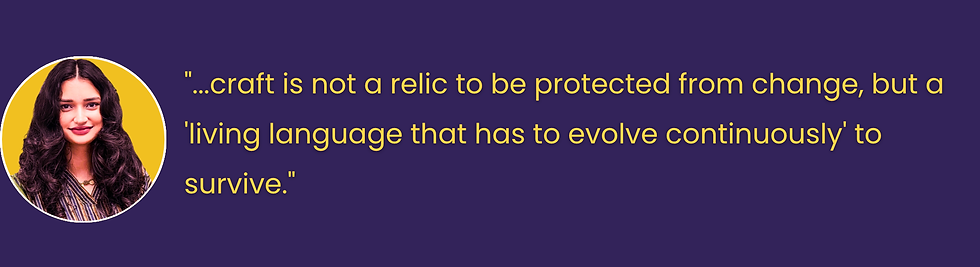
The conversation around cultural preservation is often trapped in a romantic but unsustainable logic. It treats craft as a static artifact, a relic to be perfectly preserved behind museum glass and shielded from the corrupting influence of the modern world. This approach, while well-intentioned, effectively sentences a craft to a slow, dignified death. Shailja Sachan’s philosophy offers a pragmatic and more resilient alternative. She argues that craft is not a relic to be protected from change, but a "living language that has to evolve continuously" to survive. This doctrine reframes the work for sustainability leaders. The goal is not to document the past, but to ensure that a craft remains a viable, thriving part of a community’s present and future. This belief frames evolution not as a threat to a craft’s identity, but as the only path to ensure its continuity. It is a fundamental shift from preservation as a static act to preservation as a dynamic, ongoing process of adaptation and engagement with the contemporary world. A language that stops evolving becomes extinct. Sachan argues that the same is true for the intricate cultural languages we call craft.
The Friction of Co-Creation
For this evolution to be authentic and sustainable, it cannot be an extractive process. Sachan’s methodology opposes the model where an outside designer issues directives to artisans, treating them as a technical "pair of hands". This approach strips the craft of its cultural soul and reduces a deep-seated tradition to a mechanical technique. Her alternative introduces the intentional friction of co-creation. The process is slower, complex, and more demanding. It requires the designer to act as a "respectful facilitator" who first seeks to understand the craft's inherent limitations, its historical context, and its cultural significance. It is a dialogue that respects the community's ownership of its design intellectual property. This collaborative friction is not an obstacle to efficiency. The mechanism ensures the craft’s evolution is respectful and durable. It is a long-term investment in a relationship that yields far more resilient and meaningful results than a transactional exchange of a design brief for a finished product. This friction is the ethical safeguard that protects the craft's soul during its evolution.
The Beauty of Creative Limitation
This measured, respectful approach creates lasting resilience, but Sachan is honest about its limitations. The creative challenge is found precisely within that boundary. The limitation is not a problem to be solved or engineered away. It is the defining feature of the craft's soul. The work of a respectful designer is to find innovation within these authentic constraints, not to erase them for the sake of marketability. This approach transforms a potential barrier into a source of concentrated creativity. A tribal weave from Chhattisgarh traditionally uses only red, black, and white because those are the only colors available from local natural dyes. To impose a request for a different color without understanding this material and cultural reality would be an act of ignorance that violates the craft’s as well as cultural core identity. For Sachan, the creative challenge and joy are found precisely within that limitation. It is a deep engagement with the craft on its own terms, a process that values its inherent logic over the arbitrary demands of a trend-driven market. This respect for boundaries is the foundation of her sustainable design practice.

Rain-Fed Kala Cotton
This doctrine is a field-tested strategy for survival. The Bujodi weavers in Gujarat provide clear proof of concept. They historically wove heavy, coarse wool shawls for local pastoral communities. Had they continued to produce only this single, particular product, the craft would have inevitably died out as modern materials and local economies changed. The weavers, however, engaged in a process of evolution. They began using an indigenous, rain-fed Kala cotton to create contemporary products like stoles, sarees, and garments. This strategic shift allowed them to keep the craft's essential vocabulary and traditional techniques alive while significantly expanding its market and relevance. This is the expression of Sachan's philosophy in action. It is a process that requires patience and sincere respect. It is initially slower and more fraught with challenges than industrial automation, but its outcomes bring a unique value. It creates a future where craft is not a relic of the past, but a thriving driver of a community’s present and future.
The Price
This capacity for evolution, however, is not universally given. Sachan is clear: a community's ability to engage in this healthy, agentic evolution is a product of its economic and social standing. The artisans of Gujarat, historically well-off and exposed to global markets through design fairs and collaborations, are "excited by the idea of evolution." They have the confidence and the agency to experiment and co-create. This is not the case for marginalized communities in poorer areas, who have been historically overlooked. For them, a proposal to change a traditional design may be met with vehement refusal or a resigned willingness to execute orders without creative ownership. This highlights the final layer of Sachan’s work. Fostering the evolution of a living language first requires the long, patient work of building the trust, agency, and stability that makes such an evolution possible in the first place.

So what can we take from her approach?

Questions for Audience
The blog frames creative limitation (e.g., the three colors of the tribal weave) as a source of strength. In a globalized market that demands constant novelty, how can brands and designers effectively communicate the value of such limitations to consumers?
The final section highlights that agency is a "precondition" for healthy evolution. What is the ethical responsibility of a business that wishes to work with a marginalized community that currently lacks this agency? Must they first focus on agency-building before any creative work begins?


Comments