
Influence Without Internal Power

My Sustainable Encounter with Anuja (Dwivedi) Ojha
The Art of External Influence
The transition from a senior corporate role to an external consultancy presents a distinct challenge: how does one drive change without direct hierarchical power? After decades in corporate sustainability, Anuja Ojha's pivot to launching her firm in 2023 brings this paradox into focus. Her objective, apparent from the outset, was to amplify impact and accelerate crucial industry shifts. Years spent within large organizations had equipped her with an understanding of problem-solving within complex structures. This foundation, however, now serves a new purpose: external influence. The calculus shifts for a business owner: "Everything is about time and cost". This reality shapes every pitch, every recommendation, and every effort to embed sustainable practices.
Gaining Traction Without Command
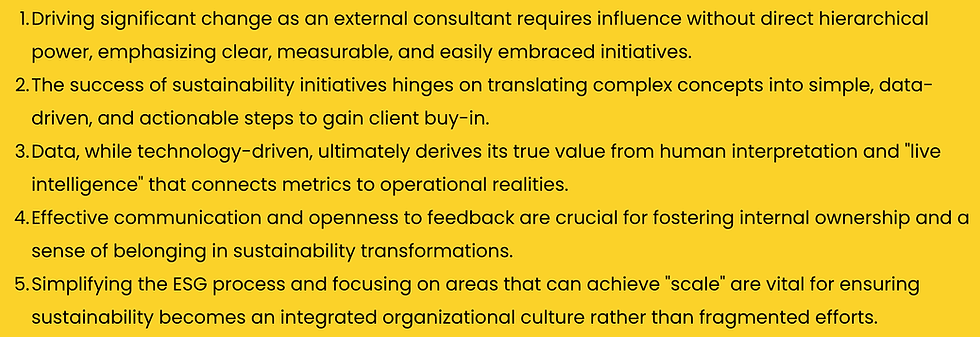
Therefore, the core challenge for a consultant involves being "an influence of change". This requires a nuanced approach, removed from issuing internal mandates. It demands identifying precise areas for progress, ensuring these initiatives are measurable, and securing genuine client embrace of sustainable practices. How does one foster ownership when direct command is absent? Ojha emphasizes the necessity to "keep it as simple as possible" while remaining "data-driven". This simplicity proves crucial in gaining buy-in from diverse client motivations. It distills complex concepts into digestible, actionable steps, making the ESG path forward clear and less daunting for organizations. This approach acknowledges that while the strategic vision might originate from an external expert, its true implementation hinges on internal receptivity.

Data's Human Intermediary
Data, while "purely technology driven," is fundamentally "driven by people". Its true essence lies with "the user and the person who analyzes the data". This interplay of technological data and "human side or live intelligence" is critical for extracting genuine value. This sophisticated understanding of data transcends mere metrics; it recognizes the human element as the ultimate arbiter of meaning and actionable insight. A consultant's role, then, extends beyond delivering reports; it involves interpreting data in a way that resonates with the client's operational realities and strategic objectives. Furthermore, fostering a "free flow of communication and being open to feedback" is paramount. Even if immediate change is not feasible, acknowledging feedback ensures "everyone feels like they belong" and fosters a culture where sustainability is genuinely embraced and owned.

The Strategic Power of Simplification
A critical pitfall in sustainability initiatives is attempting "to do too many things". Fragmentation of efforts, or "jumping from program to program, project to project," often leads to losing "the essence" of the core objective. Simplification and focusing on areas where absolute "scale can come" is vital to maintaining coherence and achieving tangible results. Ojha's ambition for her firm centers on being known for "simplifying things". The objective is to demystify ESG, empowering organizations to "feel like they can drive it and bring in some change". This focus on making complex processes accessible ensures sustainability becomes "a culture of the organization", adaptable to changing teams and market dynamics. Is actual impact measured not solely by adherence, but by the simplicity with which complex goals are internalized, allowing them to become an organic part of an organization's character?

So what can we take from her approach?
Open Questions:
Anuja Ojha states that "everything is about time and cost" for a business owner. How can sustainability professionals effectively quantify and communicate the "time and cost" benefits of integrating sustainable practices, especially when immediate financial returns are not obvious?
If "data... is fundamentally driven by people," what innovative approaches can organizations adopt to ensure their employees, from the ground up, feel ownership and actively contribute to the integrity and insights derived from ESG data?


Comments